
The Founding of Griffin: Railroads, Vision, and a Tree Stump Auction
Spalding County approaches its 175th anniversary later this year, and we are reflecting on the people, ideas, and ambitions that shaped both the county and the City of Griffin!
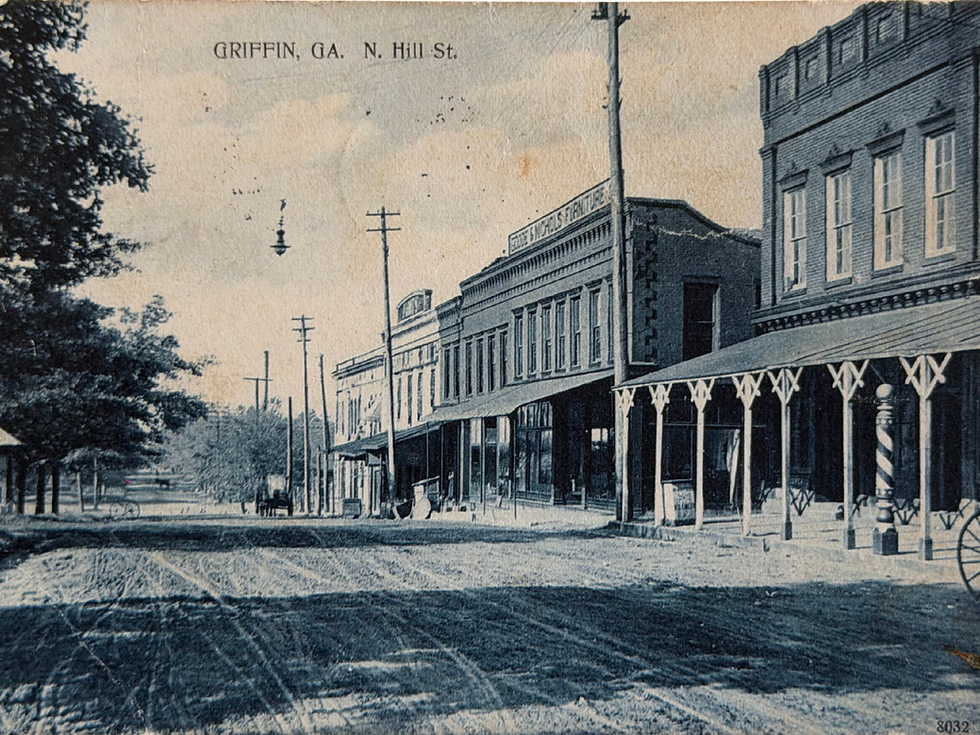
On June 8, 1840, a new city was born in what was then Pike County, Georgia. Standing atop a tree stump near a small town spring, Gen. Lewis Lawrence Griffin auctioned off the first lots of a planned railroad community that would eventually become the City of Griffin.
What began as an ambitious railroad venture grew into one of Middle Georgia’s most important commercial and agricultural centers, and helped shape the development of the region for generations to come.
A Railroad Visionary
The story of Griffin begins with railroads.
During the early 1830s, Georgia was beginning to embrace rail transportation as a faster way to connect communities, commerce, and trade. In 1833, the Monroe Railroad was chartered as one of the first railroads in Georgia designed to use steam locomotives. Gen. Lewis Lawrence Griffin served as president of the railroad company and became one of the state’s earliest railroad advocates.


The Monroe Railroad initially operated between Macon and Forsyth, but Gen. Griffin believed the line could become part of a much larger transportation network linking Georgia’s major trade routes.
At the time, several railroad projects were developing across the state. One line connected Savannah and Macon, another linked Augusta and Madison, and a fourth route was being planned from a small North Georgia settlement called Terminus to Chattanooga, Tennessee.
Gen. Griffin envisioned these railroads eventually crossing at a central point in Middle Georgia, creating a major inland city and transportation hub. According to his calculations, that crossing point would occur on land owned by Bartholomew Still in Pike County.
Founding a New City
Believing strongly in the future of rail transportation, Gen. Griffin purchased approximately 800 acres from Still in 1840 and laid out plans for a new town. On June 8, 1840, he held a public auction near the town spring, selling the first lots of the new community to the highest bidders. Historical accounts note that the first lot was sold to William Leake for $1,000.
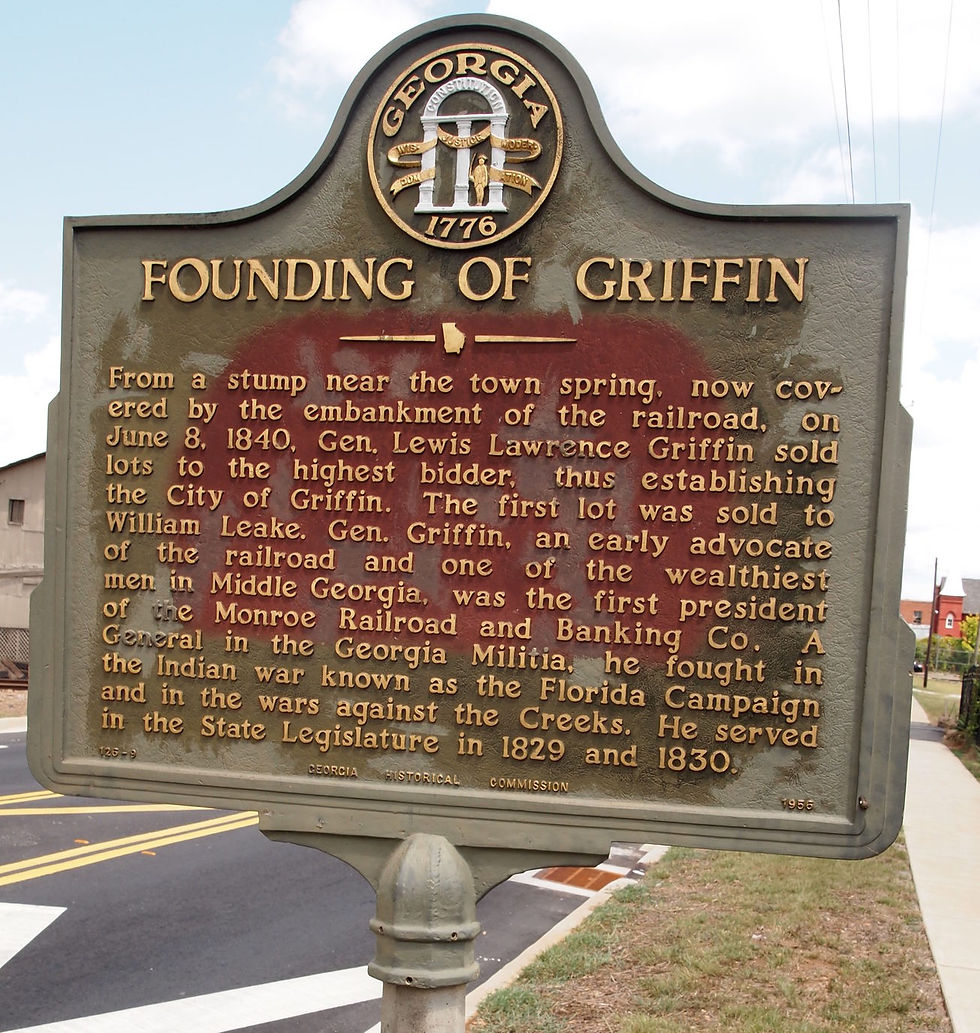
The city was named in honor of its founder, Lewis Lawrence Griffin, and a historical marker on West Broad Street still commemorates that day:
“From a stump near the town spring, now covered by the embankment of the railroad, on June 8, 1840, Gen. Lewis Lawrence Griffin sold lots to the highest bidder, thus establishing the City of Griffin.”
Economic Hardship and Railroad Collapse

Despite Griffin’s ambitious plans, the project soon faced major difficulties.
A severe business depression in the early 1840s created financial problems for railroad companies throughout the South. The Monroe Railroad struggled economically and eventually collapsed before Griffin’s broader vision could be fully realized.
Although the original company failed, the railroad route itself survived. When Monroe Railroad and Banking Company was sold at a foreclosure auction in 1845, it became the Macon & Western Railroad Company. This allowed for the route itself to continue development. The Macon & Western later merged with the Central Railroad and Banking Company of Georgia in 1872.
The major railroad crossing Griffin had predicted ultimately shifted slightly northward, where the city of Atlanta would later emerge as Georgia’s dominant rail hub. Even so, Griffin continued to prosper and develop in its own right.
Growth of a Community
During the decades that followed, Griffin became an important center for agriculture, manufacturing, and commerce in Middle Georgia. The city was formally incorporated by the Georgia General Assembly on December 28, 1843. A few years later, on December 20, 1851, Spalding County was created from portions of Fayette, Henry, and Pike counties and was named for Georgia statesman Thomas Spalding. The newly formed county selected Griffin as its county seat.
By the late nineteenth century, Griffin had developed into a thriving Southern community with strong railroad connections, textile manufacturing, cotton commerce, and a growing downtown business district.
Remembering Griffin’s Origins
Today, Griffin’s founding story remains deeply connected to the railroad vision of Gen. Lewis Lawrence Griffin and the determination of the early residents who helped establish the community.
From a simple auction on a tree stump near a spring, a city emerged that would endure for generations and become an important part of Georgia’s history!

Comments