
the Bailey~Tebault House History
The Bailey-Tebault House stands as one of Griffin’s finest examples of Greek Revival architecture, offering a window into 19th-century life in the region. Built by David Jackson Bailey and his wife, Susan Mary Grantland, the home reflects both the family’s status and their commitment to the Griffin community. Today, the Griffin-Spalding Historical Society preserves and maintains the house, welcoming visitors to explore its architecture, grounds, and rich history.
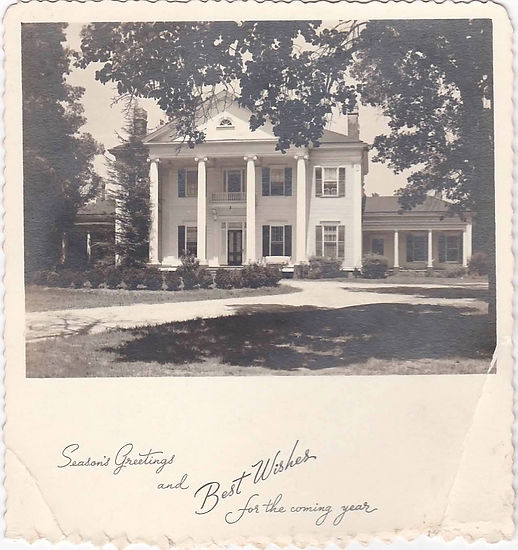
The Bailey-Tebault House was built by David Jackson Bailey and his wife, Susan Mary Grantland. Mrs. Bailey was the daughter of Seton Grantland, newspaper editor in Milledgeville, Georgia. David Bailey served in the state legislature and was elected to the U.S. Congress in 1850. While the Baileys maintained a large property in Butts County, they chose Griffin for its educational opportunities and vibrant community life. Today, the Griffin-Spalding Historical Society preserves the home and welcomes visitors to explore its architecture, grounds, and rich historical legacy.
Construction and Early Years
Construction began in 1859 and was completed in 1862, delayed by Union blockades that held up the shipment of millwork from Philadelphia. The house was built on 14 acres just outside the developed area of Griffin, near the Plank Road to Flat Shoals, a key thoroughfare for cotton transport and stage travel. The New York and New Orleans Mail Line traveled this route, one of the most reliable in the country. The Baileys made Griffin their primary residence upon completion. Family stories note that during their move, Mr. Bailey’s extensive library was scattered from Griffin to Jackson by Federal troops. The home is celebrated for its Greek Revival style, with exceptional proportions, detailed millwork, a curving staircase, and projecting plaster crown moldings in the hallway. Fireplaces in the double parlors were once closed, but today feature restored mantels donated from the former Beeks home by Mr. and Mrs. James S. Murray.
Architecture and Grounds
Originally, the kitchen was detached and connected to the house via an underground passageway; today it is linked through a galley area. The property includes three dependency buildings behind the main house:
-
Aunt Sophie’s Cottage: Read more on our Slave Dwelling Preservation Initiative.
-
Carriage House: Equipped with a fireplace.
-
Apothecary Building: Located closest to the kitchen door.

The house has 6 bedrooms (the two bedrooms on the first floor have since been converted to dining rooms) and accommodated the Baileys’ 11 children (six survived to adulthood), with children’s bedrooms upstairs and Mr. and Mrs. Bailey’s bedrooms on the first floor. Both first-floor bedrooms included unusually large closets, and Mrs. Bailey’s bedroom was connected to the upstairs through an early intercom tube system.
Family Live During & After the Civil War
When David Bailey left to serve in the Confederate Army, Mrs. Susan Bailey and their children remained in Griffin. Toward the end of the war, the Bailey-Tebault House is believed to have been used as a hospital, a role common among large homes near Camp Stevens, where Confederate troops trained. Etched names still visible in the windows of the Cheatham Parlor bear witness to this period. Several of the Bailey daughters would later marry officers who trained at the camp, linking the family closely with the Confederate cause.
Following the war, the Baileys remained active in community life. They were instrumental in organizing St. George’s Episcopal Church, and in 1871 Mrs. Bailey donated its stained glass windows. In 1889, Griffin’s first commercial telephone call was made to Col. Bailey, who served as central office manager, underscoring the family’s prominent role in the city’s development. Like many wealthy Southern families of the time, however, the Baileys’ household and prosperity were built on the labor of enslaved people.
Among those enslaved at the Bailey-Tebault House was Sophie (also recorded as Sophy or Sophia), one of the most enduring figures connected to the property. Born in Georgia in 1807, Sophie lived much of her life in bondage to the Bailey family. Census records from 1900 list her as Sophia “Bailey,” a widowed mother of twelve children, and note that her parents were an enslaved woman from Virginia and a man from Africa, linking her story directly to the transatlantic slave trade and its legacy in Georgia.
Sophie lived in the largest of the Bailey-Tebault outbuildings, a duplex-style slave dwelling. Even after emancipation, she remained on the property in the cottage behind the main house. Letters and anecdotes suggest a lifelong bond between Sophie and Mrs. Bailey. Family stories recall Mrs. Bailey turning to her companion with the familiar phrase, “Aunt Sophie, take your dram,” as the two shared drinks together on the back porch.
Sophie’s presence on the grounds until the late 1890s reflects both her importance within the Bailey household and the complexities of life for formerly enslaved people after the Civil War. She is believed to have died in Griffin between 1900 and 1910, leaving behind a legacy deeply intertwined with the history of the Bailey-Tebault House.
Later Years and Ownership
The house passed through the Bailey family after Mrs. Bailey's death, eventually inherited by Sallie Bailey Tebault, and later to her descendants. Around 1909, the house became Griffin’s first hospital and school for nurses, and by 1940 it was converted to the Frank S. Pittman Funeral Home. In 1971, James Rawls purchased the property, renaming it the Pittman-Rawls Funeral Home.
The Griffin-Spalding Historical Society acquired the house on May 1, 1987. During renovations in 1989, the arch between the two main parlors was reshaped, paneling installed, and the original double doors restored in spirit.
Preservation and Furnishings
Several original and family-related furnishings remain in the home. The large dining table in the Blakely Dining Room was donated back to the Society, and a sideboard in the Hightower Dining Room was returned after being purchased at a Bailey descendant estate sale. Together, these elements help preserve the history and legacy of the Bailey family and the home itself.

.jpg)

.jpg)

The Mary Smalley Garden at the rear of the home was established by The Garden Club of Griffin in her memory in 1995. The Club, founded in 1923, became one of the first clubs in The Garden Club of Georgia when it was established in 1928.
